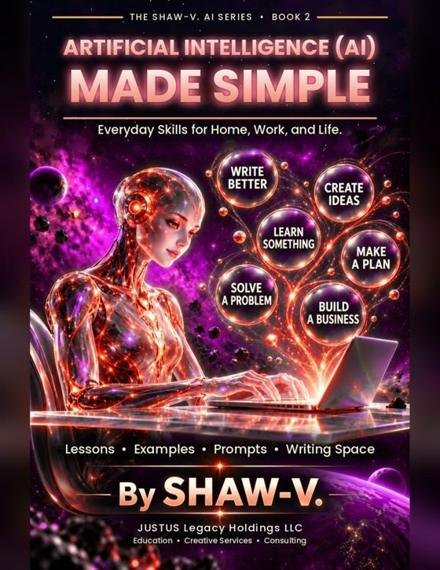
Artificial Intelligence (AI) Made Simple
Chapter 1: Find your point and your reader
Decide what you want to say and who you are saying it to before you write.
Most writing problems start before the first word. A message feels messy when the writer has not decided what it is for. A post sounds flat when it tries to say five things at once.
Good writing starts with two choices: your main point and your reader. Once you know both, every other choice gets easier, from the words you use to how long the piece should be.
AI tools such as ChatGPT, Claude, and Gemini can help you think. They are quick at asking questions and offering options. They can only guess what you mean until you share it, so you do the deciding and let AI help you sharpen it.
Lesson 1: Turn a topic into a point
A topic is what you will talk about. A point is what you want the reader to understand, believe, or do. "Our summer program" is a topic. "Our summer program gives teens paid work experience close to home" is a point.
Write your point as one sentence under 25 words. If it will not fit, you may have two pieces tangled together. Split them and handle one at a time.
Test it by imagining your reader asking, "So what is the bottom line?" Your quick answer is your point.
Lesson 2: Picture your reader
Ask three questions about your reader. What do they already know? What do they need from you? How do they feel about the topic?
A beginner needs simple words and short steps. A busy expert wants the key fact first. A worried reader needs calm, clear facts.
Purdue OWL's guide to audience analysis teaches the same idea: learn who your readers are and what they need before you write.
Lesson 3: Name the job
Most writing does one of three jobs. It informs, it persuades, or it asks the reader to act.
Writing that informs should be calm and complete. Writing that persuades needs reasons and proof. Writing that asks for action needs a clear request, a deadline when there is one, and an easy next step.
When you know the job, you know what to keep and what to cut.
Worked example: From a fuzzy idea to a clear point
BEFORE: "I want to write something about my cooking class and how it helps people and also the prices and maybe the new location."
AFTER: Point: "My Saturday cooking class teaches busy parents five quick, low-cost dinners."
Reader: parents who are short on time.
Job: ask them to sign up.
Save for later: the full price list and the new location.
Why it works
- The point names one reader and one promise.
- The job is clear, so the message can end with a sign-up step.
- Extra topics wait for another message instead of crowding this one.
AI Practice Lab
Use AI as a thinking partner. You bring the idea, and AI asks questions and offers options.
FIND MY POINT
I want to write about [topic] for [reader]. Ask me five short questions, one at a time, to help me find my single main point. Do not write the piece for me.
TEST MY POINT
Here is my main point: [sentence]. Is it a topic or a real point? If it is vague, give me three sharper versions that keep my meaning. Do not add facts I did not give you.
KNOW MY READER
I am writing to [reader]. Help me describe them by asking what they know, what they need, and how they feel about this topic. Then write a three-sentence reader profile from my answers.
Check it yourself: AI may suggest a point that sounds better but is not what you mean. Keep only what is true for you.
Want to keep reading?
© 2026 SHAW-V. Published by JUSTUS Legacy Holdings LLC.